
How to verify a Dubai contractor: registration, classification, portfolio checks, site visits, references and financial standing.
Every contractor presents well. The portfolio has good photography, the company profile lists impressive locations, the sales meeting is confident, and the reference the client is offered speaks warmly. None of that distinguishes a contractor who will deliver your project from one who will not, because presentation is the cheapest thing a contracting company can produce.
What distinguishes them is verifiable evidence: registration that can be checked, classification that matches the scale of your project, completed work you can visit or trace to a named address, financial standing that supports the cash flow your build demands, and a team that stays with the job after the contract is signed. All of that is available to a client willing to ask for it, and most of it takes a few hours rather than a few weeks.
This guide sets out how to verify a Dubai contractor properly — what to check, where to check it, what a satisfactory answer looks like, and which patterns in an otherwise strong presentation should make you slow down. It reflects what we see when clients come to us after an appointment elsewhere has gone wrong, and what we would want a client to ask us before appointing our own general contracting team.
Part one: registration and classification, which became stricter this year
The regulatory baseline in Dubai changed recently, and the change is directly useful to clients evaluating contractors.
Dubai Media Office announced that Law No. 7 of 2025 regulating contracting activities in the Emirate was issued in July 2025, strengthening the legal and governance framework of the emirate's contracting sector. The law came into force on 8 January 2026, with a one-year grace period running to 8 January 2027 for existing contractors to bring themselves into compliance. As of now, that deadline sits a few months away, which makes a contractor's registration status a live question rather than a formality.
Three features of the framework matter to a client choosing a contractor:
A central Contractor Register. Maintained by Dubai Municipality and integrated with the Invest in Dubai platform, the Register covers contracting activity across the emirate including free zones and special development zones such as the DIFC. Employers are prohibited from engaging contractors who are not registered and classified in accordance with the law, which makes verification the client's responsibility as well as the contractor's.
Classification limits that are enforceable. Contractors must operate strictly within their approved classification and capacity, and are prohibited from exceeding their technical or financial limits or subcontracting without prior approval. A contractor whose classification does not cover the height or value of your project cannot lawfully take it, regardless of how confident they are about the work itself.
Penalties with real teeth. Gulf News reported that violations attract fines ranging from AED 1,000 to AED 100,000, with repeat offences within a year doubling to as much as AED 200,000, alongside suspension from contracting activities, downgrading of classification, removal from the registry and cancellation of commercial licences.
What this means practically. Ask for the trade licence, the Dubai Municipality classification and the Contractor Register status, and verify them rather than accepting a PDF. Confirm the classification grade covers your project's scale and building height. Confirm the licence activity actually covers the work — a contractor licensed for fit-out is not licensed for structural construction. And where your project sits under Trakhees or the Dubai Development Authority rather than Dubai Municipality, confirm registration with that authority specifically, since DM registration alone does not carry across jurisdictions.
A contractor who produces all of this within a day has it in order. A contractor who needs a week is telling you something.
Part two: reading a portfolio properly
Portfolios are marketing documents, and they are constructed to be read quickly and favourably. Reading one properly means slowing down on four questions.
Did they build it, and in what role? A project can appear in a portfolio because the company was the main contractor, or a subcontractor on one package, or a member of a joint venture, or the fit-out contractor after someone else built the shell. All four are legitimate, and they represent entirely different capabilities. Ask directly what their scope was on each project you care about, and what the contract value of their portion was rather than the value of the development.
Is the project named and locatable? A portfolio entry reading "luxury villa, Dubai" cannot be verified. An entry naming a community, a development or a client can be. Contractors with real completed work generally name it — our own project pages identify the Elite Villa at Dubai Hills, the villa in Jumeirah and the Meat Moot restaurant at Al Khawaneej precisely because a named address is checkable and an anonymous one is not.
Do the projects resemble yours? Resemblance means type, scale, complexity and location, in that order. A contractor with ten completed villas and no towers is the right choice for a villa and the wrong one for a tower, however capable. A contractor who has never built in your specific community will spend the first weeks learning developer procedures and community access rules that an experienced one already knows. And a contractor whose portfolio is entirely shell-and-core has a different capability from one who has delivered finished, occupied buildings — a distinction worth understanding through the phases of a construction project.
How recent is the work? A portfolio weighted toward projects completed five or more years ago raises a question about what has happened since. Teams change, key people leave, and a company's current capability may bear limited relation to its historical one. Ask what they have completed in the last eighteen months, and what is on site right now.
Part three: the site visit, which is the single most informative hour available
Photographs show finished work in good light. A live site shows how a contractor actually operates, and clients who make one site visit before appointing learn more than they would from any amount of documentation.
Ask to visit a project currently under construction. A contractor confident in their operation will arrange it. Hesitation is itself an answer.
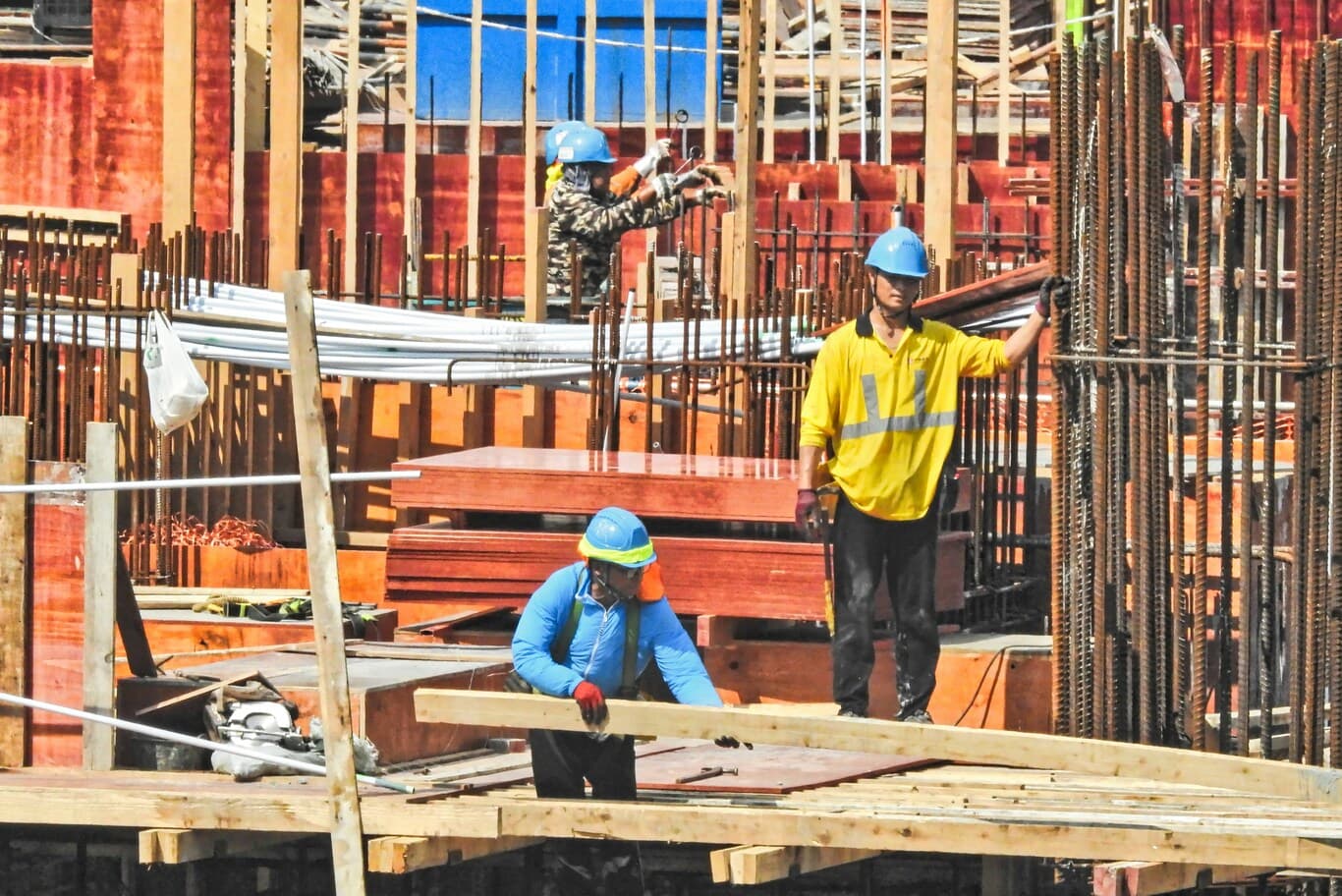
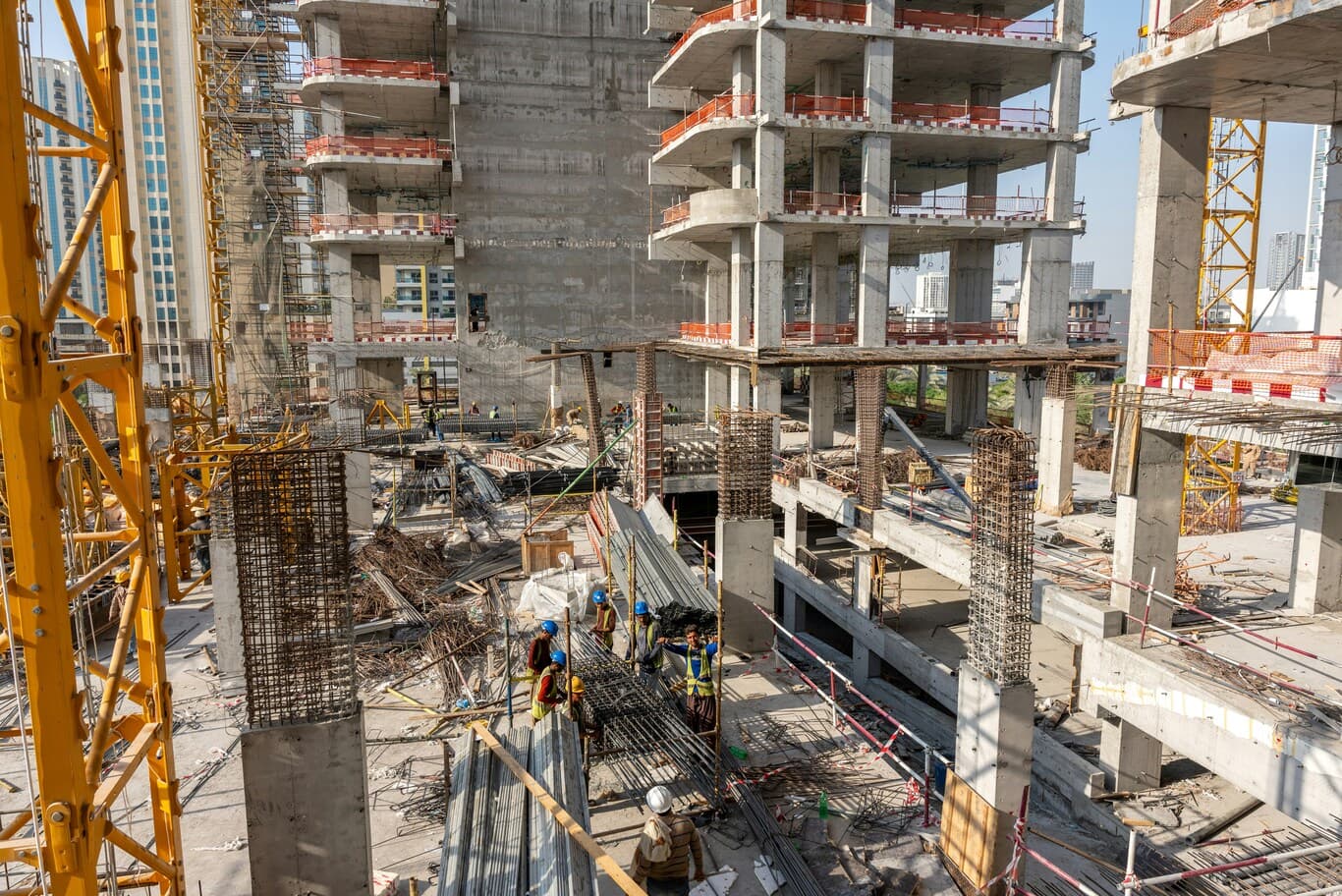
On site, look at housekeeping — a tidy site with clear access routes, organised material storage and managed waste reflects a management culture that carries into quality and safety. Look at whether personal protective equipment is worn consistently rather than produced for the visit. Look at protection of completed work, since a contractor who protects finished surfaces is a contractor who expects to hand them over undamaged. Look at whether drawings on site are current and controlled, or dog-eared copies of superseded revisions.
Then talk to the site team. Ask the project engineer what the current programme status is and whether the project is on schedule. Ask what the main challenge has been. A team that answers openly, including about difficulties, is a team operating with management support. A team that defers every question to the commercial manager is a team that has been briefed.
Ask also to see a completed project. Two or three years after handover, the quality of workmanship has had time to declare itself: movement cracking, sealant failure, staining below drainage, door alignment, the condition of external finishes. Dubai's climate is a reliable test of specification and workmanship, and it applies that test quickly.

Part four: references, and the questions that produce useful answers
A contractor supplies references who will speak well of them. That is not a criticism, simply the nature of the exercise, and it means the value of a reference call lies entirely in the questions asked.
Questions producing generic praise: Were you happy with the work? Would you recommend them? Did they do a good job?
Questions producing information:
- Did the project finish on the original contract date, and if not, by how much did it move and why?
- What was the final account against the contract sum, and what drove the difference?
- How many variations were raised, and how were they priced and agreed?
- Who was your day-to-day contact, and did that person stay for the whole project?
- What went wrong, and how did they handle it when it did?
- What would you do differently if you were appointing again?
- Would you appoint them again for the same project, and for a larger one?
The fifth question is the most revealing. Every project has a problem. The reference's account of how it was handled tells you what happens when your project has one — and that account is usually given candidly, because it reflects on the contractor's conduct rather than on the reference's judgement.
Beyond the supplied list, ask for a reference from a project that did not go smoothly. A contractor willing to give you one is unusual and worth taking seriously. Consultants and project managers who have worked opposite the contractor are also valuable, since they assess from a technical position rather than a client one, and their view of a contractor's documentation, claims conduct and coordination is usually sharper.
Part five: financial standing, which is the failure mode clients least expect
Contractor insolvency mid-project is the most damaging outcome in construction procurement, and it is rarely predicted by the quality of the work being done. A contractor can be building beautifully and running out of money at the same time.
The indicators worth establishing:
- Audited financial statements for the last two or three years, showing turnover, profitability and balance sheet strength
- Turnover relative to your project value. A project representing a large share of a contractor's annual turnover concentrates their exposure and yours
- Current workload. A contractor whose order book has expanded rapidly may be resourced for the volume or may be stretched across it
- Bank references and bonding capacity, which indicate whether financial institutions assess them as sound
- Payment behaviour toward subcontractors, established through the supply chain rather than through the contractor. Subcontractors who are paid late are subcontractors who will demobilise from your site first
- Insurance in force: contractor's all-risk, third-party liability, workmen's compensation, and professional indemnity where design responsibility is carried
A price substantially below the others in a tender is a financial signal rather than a commercial opportunity. It usually indicates an error in the take-off, an intention to recover through variations, or a contractor buying work to fund existing commitments. All three end badly for the client, and the dynamics behind them are covered in our guidance on keeping a construction budget under control.
Part six: the team, which is what you are actually buying
A contracting company does not build your project. A specific project manager, a specific site engineer and a specific team build your project, and the gap between a company's best team and its weakest one is wider than the gap between two companies.
Ask who will be assigned, by name. Ask for their CVs and the projects they have personally delivered. Ask whether they are currently committed elsewhere and when they become available. Ask how many other projects they will run concurrently with yours. Ask what happens if that person leaves mid-project.
Then ask which trades are self-performed and which are subcontracted. A contractor who self-performs structural works retains direct control of the programme's critical path, while one who subcontracts everything is a coordination layer whose performance depends entirely on their supply chain. Both models work; they carry different risk, and the difference should be understood rather than discovered. The management discipline involved is set out in our guide to running subcontractor packages on large projects.
Ask, finally, about senior involvement. On projects at our end of the market, clients reasonably expect a director to remain accessible throughout rather than appearing at the contract signing and again at handover.
Part seven: process and documentation
How a contractor documents work predicts how the project will run, and a request to see their systems is entirely reasonable before appointment.
Ask to see a construction programme from a live project — a resourced, logically linked programme with a genuine critical path, rather than a bar chart produced for the tender. Ask to see a sample monthly report. Ask how variations are instructed and priced, and what the turnaround is. Ask what quality management system governs inspections, and what the inspection and test plan looks like for a structural package. Ask how HSE is managed and what certifications the site team holds.
Ask how authority approvals are handled and whether submissions are prepared in-house. A contractor who runs approvals internally controls that part of the programme; one who subcontracts it inherits someone else's queue. The demands involved are visible in our walkthroughs of approvals for commercial fit-out works and the permits required before renovation begins.
Ask what the handover pack contains. A contractor who describes as-built drawings, commissioning records, material certificates, warranties and O&M manuals without prompting has assembled one before. Our note on snagging and defect close-out sets out what a complete pack looks like.
Part eight: patterns worth slowing down for
None of the following is proof of anything on its own. Two or three together justify further checking.
Reluctance to arrange a site visit. Portfolio projects that cannot be named or located. A price materially below the field with no explanation of where the difference sits. Pressure to sign quickly, or a discount contingent on signing this week. Reluctance to name the assigned project manager. Vagueness about which trades are self-performed. A classification that does not obviously cover your project's scale. Documentation produced slowly. References confined to a single client or a single project type. A request for a large advance payment without a corresponding bond. And an unwillingness to discuss a project that went wrong, which every contractor with a real history has.
The pattern connecting most of these is a preference for speed over verification. A contractor comfortable being checked will encourage the checking.
Part nine: a practical sequence
The verification work fits into a fortnight if it is sequenced rather than bundled.
Begin with documents: trade licence, classification, Contractor Register status, insurance certificates, audited accounts. Then assess the portfolio against your project type, scale and location, and identify two or three genuinely comparable projects. Then visit — one live site, one completed project of similar type. Then call references, using the questions in Part four and adding a consultant or project manager where possible. Then meet the proposed project team rather than the sales team. Then review process documents: a live programme, a sample report, the quality and HSE systems. Then, and only then, compare prices, with each price understood in terms of what it includes and what it assumes.
Price compared before capability is established is price compared in the dark. The work above is what converts a number into information, and it is considerably cheaper than the alternative. Further context on how delivery models change what you are evaluating sits in our overview of construction in Dubai end to end and our construction management service.
Bring us your project
Capital Associated holds an active Dubai Municipality trade licence with the classifications required for structural construction work, carries contractor's all-risk, professional indemnity and third-party liability cover, and operates under documented quality and HSE systems with inspections recorded at every construction milestone. Our completed projects — villas in Dubai Hills, Jumeirah and Tilal Al Ghaf, and restaurant builds at City Walk, JBR and Al Khawaneej — are named, located and available to visit.
Tell us about your project. Complete the project enquiry form with your project type, location, approximate built-up area, budget range and intended start date. A senior member of our team will respond with an initial assessment, and we will provide our licence, classification, insurance certificates and reference contacts alongside it rather than waiting to be asked.
If you are evaluating several contractors, take the questions in this guide to all of them, including us. The comparison is more useful when everyone answers the same questions, and a contractor worth appointing will welcome being measured against them.