

Snagging in Dubai construction explained: defect types, inspection process, DLP timelines, legal rights under UAE law, and what contractors must fix before handover.
Most construction defects are not discovered during construction. They surface at the moment someone walks through a finished property with fresh eyes and a checklist. Tiles that sound hollow when tapped. Paintwork with shadows and holidays. A bathroom exhaust that runs but does not draw. A door that closes but leaves a gap at the hinge side. These are snags — individually minor, collectively significant, and in Dubai, subject to a legal framework that determines exactly who is responsible for fixing them and for how long.
Snagging sits at the junction of construction and ownership. Understanding the process, the rights, and the timelines involved makes the difference between a clean handover and an expensive dispute.

What Snagging Means in a Construction Context
Snagging refers to the systematic inspection of a completed building or space to identify defects, incomplete works, and items that do not meet the agreed specification. The inspection happens at, or just before, practical completion — the point at which the structure is considered finished enough to be handed over, even if minor items remain outstanding.
The term originates from British construction practice and is standard terminology across the UAE market, where the UK-influenced project management frameworks have shaped how main contractors and developers operate. In US practice, the equivalent document is called a punch list. The function is identical: a written record of every item the contractor must address before the client accepts the keys.
Snagging is not the same as a final inspection conducted by a building authority for occupancy certification. That process checks code compliance. Snagging checks workmanship, finish quality, and contractual specification. Both matter, but they answer different questions.
The post-construction snagging, defects, and handover checklist published by Capital Associated covers the contractor-side perspective in detail. This article focuses on the full process — from the legal basis through to what happens when a developer does not respond.

Dubai's Legal Framework for Construction Defects
Dubai's property handover process operates under a structured regulatory framework administered by the Dubai Land Department (DLD) and the Real Estate Regulatory Agency (RERA).
The primary legislation governing defect liability is Law No. (6) of 2019 Concerning Ownership of Jointly Owned Real Property in the Emirate of Dubai. Under this law, developers carry a ten-year liability for structural defects and a one-year liability for mechanical, electrical, and plumbing defects from the date of formal handover. These are not discretionary commitments — they are statutory obligations that apply regardless of what a sale and purchase agreement says.
For off-plan buyers, the sequence works as follows. The developer issues a completion notice after obtaining a building completion certificate from the relevant authority. The buyer then has a window — thirty days in most cases — to complete all handover formalities, including the snagging inspection, final payments, and title deed issuance. Defects documented during the pre-handover inspection remain the developer's responsibility to fix. This is why the snagging inspection must be completed before the handover certificate is signed, not after.
The Defect Liability Period (DLP) begins on the formal handover date, not on the move-in date. This distinction matters. Buyers who move in some weeks after signing the handover certificate may believe they have a full year from occupation. The clock started earlier.
If a developer acknowledges receipt of a snag report but does not begin or complete remediation within a reasonable period — RERA guidance suggests thirty to ninety days for standard items — the buyer's first step is a formal written reminder with a specific completion deadline. If the developer remains unresponsive, escalation moves to the Dubai Land Department's enforcement mechanisms and, if necessary, to the Dubai Courts.
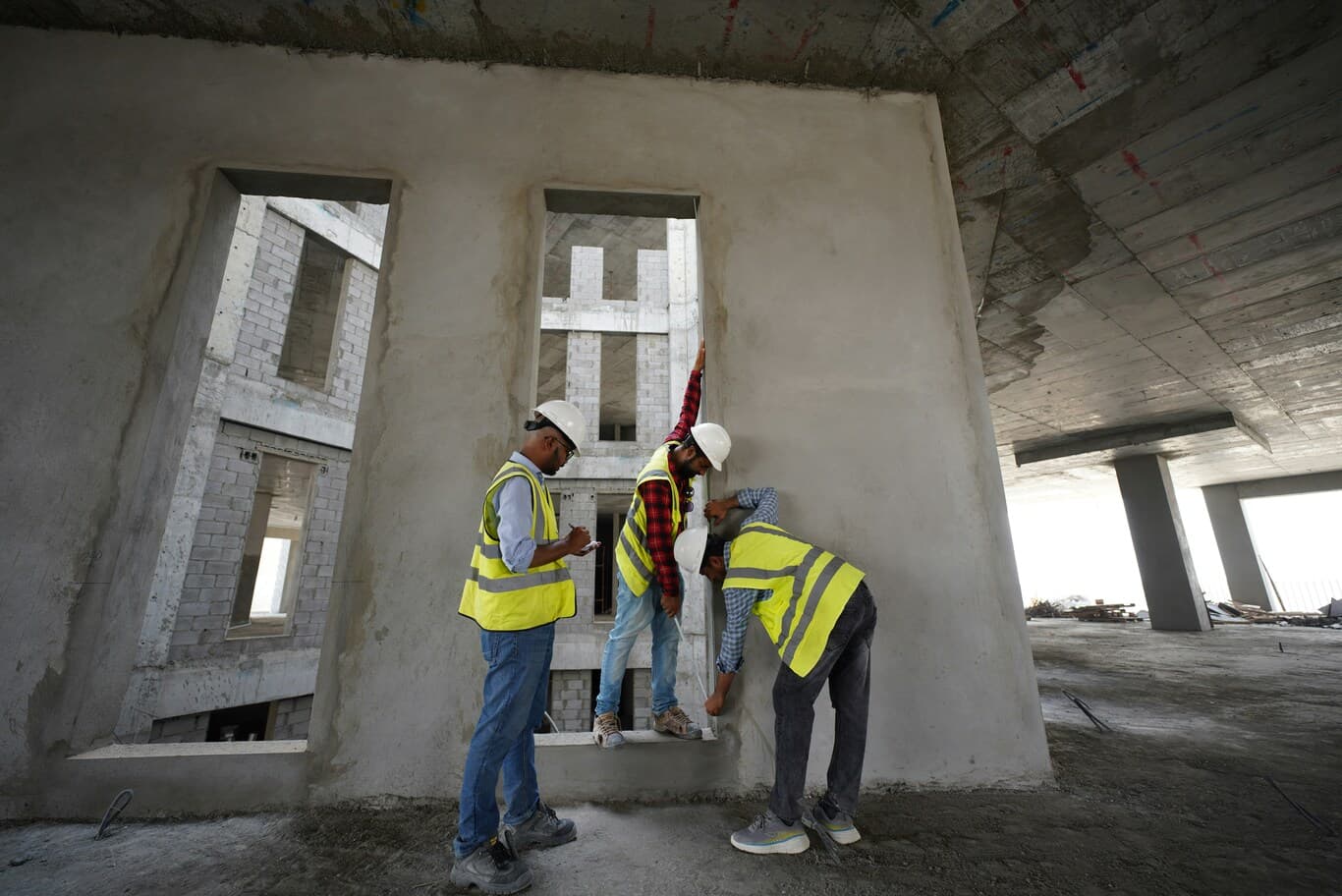
The Five Categories of Construction Defects
Snags fall into five broad categories. Understanding which category a defect belongs to affects both the urgency of the inspection and the legal basis for claiming remediation.
Forgotten items are works specified in the contract that were simply never done. Missing door stops, absent switches, omitted threshold strips, and uninstalled towel rails are common examples. These items are usually straightforward to remedy because no dispute exists about the specification — the item is on the drawings and it is not on the wall.
Incomplete works are items that were started but not finished. Grout lines that are 80% filled. Paint that covers the wall but not the reveal. Silicone that runs out three-quarters of the way along a joint. These tend to accumulate toward the end of a project when subcontractors are demobilising and attention is shifting to the next job.
Defective workmanship covers items that were done but done incorrectly. Tiling that does not drain properly because the falls were set wrong. Plaster that is out of vertical by more than the permitted tolerance. Timber that was installed before it had acclimatised to the site humidity. The scope here can range from cosmetic to structural, depending on the element involved.
Material or component failures involve items that were correctly installed but have either failed prematurely or arrived damaged. A window seal that has already separated. An HVAC diffuser that vibrates at a specific fan speed. A sanitary fitting with a hairline crack that was not visible during installation. These are covered during the DLP and typically involve a warranty claim to the supplier as well as a remediation obligation on the contractor.
Latent defects are the most complex category. These are defects that exist at handover but are not visible during the initial inspection — concealed waterproofing failures, hidden structural cracks, or drainage gradients that only cause problems when a heavy rainfall event occurs. UAE law covers structural latent defects for ten years, which reflects the time it can take for some failure modes to manifest.
The most common snags found in Dubai properties during professional inspections include uneven paint and finishing, hollow floor tiles, water ingress in wet areas, misaligned doors and windows, AC systems that do not cool to specification, non-functional electrical outlets, insufficient waterproofing on balconies and terraces, and HVAC drainage issues. Identifying trustworthy contractors before a project starts reduces the frequency of these issues significantly, but no project exits construction entirely free of snags.

How a Professional Snagging Inspection Is Conducted
A professional snagging inspection follows a structured sequence. The goal is comprehensive coverage, documented in a format that can be submitted to the developer and, if necessary, to RERA.
Document review comes first. The inspector collects the approved drawings, the fit-out specification, the as-built package, and any handover documents provided by the developer. Every defect identified during the walkthrough is measured against this specification, not against the inspector's own expectations. A wall colour that the buyer does not like is not a snag. A wall colour that does not match the approved finish schedule is.
The physical walkthrough proceeds room by room and system by system. Walls and ceilings are checked for cracks, uneven plaster, paint holidays, and bulging. Floors are checked by tapping for hollow tiles — in dry areas, localised voids of up to 20% may be acceptable under some project specifications, but in wet areas and balconies, no hollow tiles should be accepted. Doors and windows are opened, closed, and locked repeatedly. Electrical outlets are tested. HVAC is run and outlet temperatures are measured. Plumbing is tested for flow rate and checked for leaks at all connection points.
Advanced techniques are used for hidden systems. Thermal imaging (using FLIR technology) identifies cold spots in wall construction that indicate missing insulation or hidden leaks in AC ducting. A sounding rod is used to check tile bonding systematically across floor areas. Moisture meters are used on walls adjacent to wet areas and on ground-floor slabs.
The snag report is then compiled. Each item is photographed with location, description, and a severity rating. Items are categorised by trade — civil, MEP, and finishes — to enable efficient contractor follow-up. The report is formatted for direct submission to the developer's site team and, where necessary, to RERA.
The general contracting services provided by Capital Associated include pre-handover snagging coordination as part of the project closeout sequence. For clients managing their own handover, the process above reflects industry standard practice across Dubai and Abu Dhabi.
The Contractor's Obligations During Snagging
From the main contractor's position, the snagging period is a defined phase of the project, not an afterthought. The contractor compiles an internal snag list before the client inspection takes place, addressing known issues before they are formally recorded. This is sometimes called an inspector-in-chief walkthrough or a QA pre-snagging check.
When the client or client's representative conducts the formal inspection, the contractor's site manager accompanies them, acknowledging each item and accepting or contesting it. Items that are accepted become the contractor's remediation obligation. Items that are contested go to the contract administrator or project manager for determination.
The contractor then produces a remediation programme — a timed schedule showing which trade is responsible for which snag and when each item will be cleared. For large developments with hundreds of snags across multiple units, this programme is managed using snagging software that tracks each item through to closure. The role of construction management in Dubai projects encompasses this phase, and the project manager's responsibility during snagging is to hold each trade accountable to the remediation programme.
Once all snags are cleared, the contractor calls for a de-snagging inspection. This is a follow-up walkthrough to verify that each item on the original list has been resolved to the required standard. Items that have been correctly remediated are closed. Items that remain outstanding or have been done inadequately are re-opened. The certificate of practical completion is only issued when the snag list is cleared to the client's satisfaction.

Snagging for Renovation and Fit-Out Projects
Snagging in renovation and fit-out projects follows the same structural process as new-build snagging but with different emphasis areas. Where new-build snagging focuses heavily on MEP systems that have never been commissioned and structural finishes that have never been tested, renovation snagging must also address the interface between new work and existing structure.
Paint adhesion failures at junctions between new plasterboard and existing masonry. Grout colour mismatches between new tiling and retained tiling. New drainage that connects to ageing pipework. Electrical circuits that have been extended but not re-rated. All of these interface conditions require specific attention during the snagging inspection for a renovation.
Fit-out projects in Dubai — whether Cat A or Cat B — carry their own snagging considerations. The differences between Cat A and Cat B fit-out in Dubai affect what is being snagged: a Cat A fit-out hands over base building services, raised floors, and suspended ceilings, while a Cat B fit-out includes all partitioning, joinery, specialist lighting, and bespoke furniture. The snag list for a Cat B delivery is considerably longer and involves more trades.
The fit-out inspection phase typically takes one to two weeks for a commercial project of standard complexity, following the construction and installation period. This window includes the walkthrough, snag list compilation, contractor remediation, and final sign-off. Projects that have been built to a tight programme often carry a longer remediation tail because quality checks during construction were compressed.
Case Study: Apartment Fit-Out Handover in Business Bay
A two-bedroom apartment fit-out in Business Bay — covering 1,650 square feet across living areas, two bedrooms, two bathrooms, and a kitchen — reached practical completion after a ten-week construction programme. The client appointed a third-party inspector to conduct the pre-handover snagging.
The inspector's report recorded 47 individual snag items. The most significant items were a hollow tile area in the master bathroom covering approximately 15% of the floor, a non-functioning bathroom exhaust fan in the guest bathroom, uneven paint finish on two feature walls in the living area where the painter had switched between tins without blending, a kitchen cabinet door with a hinge misalignment that prevented full closure, and three electrical outlets in the master bedroom that were installed at slightly different heights due to a setting-out error.
The contractor issued a remediation programme spanning nine working days. The hollow tile area was assessed: the void was confined to one section and did not extend into the wet zone, so it was accepted within specification tolerance. The exhaust fan was replaced. The feature walls were repainted in full rather than touched in. The cabinet hinge was adjusted. The electrical outlets were removed, the conduit was repositioned, and the outlets were reinstalled at a consistent height. The de-snagging inspection confirmed all 47 items closed. Handover took place on the fourteenth working day after the initial inspection.
Case Study: Villa Snagging in Arabian Ranches
A newly completed villa in Arabian Ranches — four bedrooms, a majlis, and a dedicated home cinema room — reached developer handover stage at the end of Q1 2025. The buyer commissioned a professional snagging company to inspect the property before signing the handover certificate.
The snagging report identified 112 items. Critical items included waterproofing failure at the roof terrace drain where a secondary membrane had not been extended to the drain collar, an HVAC system in the home cinema room that produced a measurable temperature differential between the supply diffuser and the occupied zone (indicating insufficient duct insulation through the void), and a structural crack in the external render above a first-floor window that warranted investigation of the movement joint detailing.
The developer contested the structural crack, arguing it was superficial render cracking rather than a structural issue. An independent consultant confirmed the crack was within acceptable tolerance for render settlement and did not extend to the substrate. The item was reclassified and accepted. The waterproofing and HVAC items were remediated within three weeks. The remaining 109 items — predominantly finishes, joinery alignment, and MEP terminations — were cleared within six working days. The buyer signed the handover certificate after the de-snagging inspection confirmed closure of all outstanding items.

When the DLP Has Expired
If the Defect Liability Period has passed, the legal position shifts. Developer-funded remediation for non-structural defects is no longer available. For structural defects, the ten-year liability period still applies.
Buyers who discover issues outside the DLP window are not without options. If a defect existed at handover but was latent — not visible during the original inspection — the structural liability period may still apply. Documentation from the original snagging inspection becomes important here: if the defect area was inspected and no defect was recorded, this supports a latent defect claim. If the area was not accessible during the inspection, the argument is stronger.
For non-structural items outside the DLP, the remediation cost falls to the owner. Understanding villa and apartment renovation costs in Dubai provides a current benchmark for post-DLP remediation work, including the cost categories most commonly associated with defect correction work: bathroom waterproofing, HVAC repairs, and joinery rectification.
Snagging Documentation: What to Keep and Why
The snagging report is a legal document. It establishes what was inspected, what was found, and what was agreed as the contractor's or developer's obligation. Proper documentation protects both sides.
Every snag report should include the date of inspection, the name of the inspector, the property address, a room-by-room list of all defects with photographs, a severity rating for each item, the trade responsible for remediation, and the agreed deadline for each item. The report should be submitted in writing — by registered email or through the developer's official portal — not verbally. Verbal acknowledgements are not enforceable.
Keep copies of all correspondence: the initial report submission, any responses from the developer or contractor, the remediation programme, and the de-snagging confirmation. If the matter is ever escalated to RERA or to the DLD, a complete paper trail is the most effective form of evidence.
Do not sign the handover certificate until critical snags are either resolved or formally scheduled for resolution with a written commitment and a specific completion date. Signing the handover certificate without reservations is interpreted as acceptance of the property in its current condition.

FAQ
What is snagging in construction? Snagging is the formal inspection of a completed building to identify defects, incomplete works, and items that do not meet the agreed specification. It takes place at or just before practical completion and results in a snag list that the contractor must clear before the handover certificate is issued.
How long is the defect liability period in Dubai? For non-structural defects, the DLP in Dubai is typically twelve months from the formal handover date. For structural defects, UAE law provides a ten-year liability period. The DLP starts on the date of official handover, not the date of move-in.
Do I need a professional snagging company? Professional snagging companies bring thermal imaging equipment, sounding rods, and structured inspection methodology that a standard walkthrough does not replicate. For properties over AED 1 million, the cost of a professional inspection — typically AED 800 to AED 2,500 depending on property size — is a small fraction of the defect exposure it covers.
What if the developer refuses to fix a snag? Document every submission with timestamps and delivery confirmations. Allow the contractor or developer the reasonable remediation window set out in RERA guidance. If remediation does not follow, file a formal complaint through the RERA complaint process via the Dubai REST app, then escalate to the Dubai Land Department if needed. For significant disputes, legal counsel through the Dubai Courts is available.
What is the difference between a snag and a defect? In practice, the terms are used interchangeably. Technically, a snag is a minor item identified at practical completion, while a defect is typically used for items that emerge or are identified during the DLP. The legal obligation to remedy both is the same during the DLP window.
Can I conduct my own snagging inspection? Yes. A methodical room-by-room walkthrough with a detailed checklist, photographs, and written notes is a valid snagging inspection. Professional inspectors add technical instruments and structured reporting that produce a more defensible document, but a careful self-conducted inspection with thorough documentation is far better than no inspection at all.
How does snagging work on a renovation project? Renovation snagging follows the same principles as new-build snagging but places additional emphasis on interfaces between new work and existing structure, and on MEP work that connects new installation to ageing systems. The renovation and remodeling service at Capital Associated includes a handover inspection at the end of every project.
Capital Associated Building Contracting LLC is a top contracting company in Dubai operating across residential, commercial, and fit-out sectors throughout Dubai, Abu Dhabi, and Sharjah. For post-construction snagging coordination or to discuss your project, contact the team.