
Wage benchmarks, welfare costs, trade demand, and programme impact of the summer ban — what clients need to budget for construction labour in Dubai.
Ask any quantity surveyor who has been pricing Dubai construction projects for more than a cycle or two and they'll say the same thing: labour is the line item developers consistently under-budget, and the gap between what gets estimated at tender stage and what actually gets spent through the project's life is rarely in the developer's favour. The problem isn't that clients don't know labour costs matter — it's that most preliminary budgets account for base wages without accounting for the full cost of employing a construction worker legally and compliantly in the UAE in 2026. That gap between base wages and the true fully-loaded cost of a worker on site is where most labour budget overruns originate, and understanding it before contracts are signed is what separates a budget that holds from one that doesn't.
The size and scale of the market you're building into
The UAE construction sector is currently running at its highest absolute headcount since the Expo 2020 build cycle peak, with approximately 1.42 million workers active across the federation as of Q1 2026, according to UAE Federal Competitiveness and Statistics Centre labour data compiled in Mahad Manpower's UAE Construction Workforce Report 2026. Sector employment has grown at a 4.2% compound annual rate since the post-pandemic trough of 2020, sustained by a project pipeline of USD 308 billion in tracked construction value through 2030, of which roughly USD 184 billion sits in Dubai alone, per MEED Projects data.
MoHRE issued 187,000 net new construction work permits in 2025, up 22% year-on-year — a figure that puts concrete numbers on what clients intuitively sense when they're trying to move a project from award to site start: the market is absorbing new workers at an accelerating rate, which means competition for the available certified skilled-trade pool is intensifying, not easing.
Dubai accounts for approximately 54% of all new construction starts by permit count and a similar share of new workforce demand, driven by the Dubai Urban Master Plan 2040 implementation projects, continuing delivery across Marina, Business Bay, and Dubai Creek Harbour, and the post-Expo legacy build-out in Dubai South and Expo City. Anchor projects shaping workforce demand through 2027–2028 include Etihad Rail Phase 2 at peak roughly 12,000 workers, Wynn Al Marjan at peak roughly 8,500, and the Saadiyat cultural district programme at peak roughly 6,000. Combined incremental peak demand from these named projects sits at 65,000–72,000 workers above the 2025 baseline — which is the supply context every developer in Dubai is competing within when they need to staff a project.
Why trade category determines cost more than project size
Clients often think about labour cost in aggregate — as a percentage of total project value. The more useful frame is trade-by-trade, because the availability and cost of different skill categories varies enormously within the same market at the same time.
Mason and steel-fixer remain the largest trade categories by permit volume at 17% and 14% of active permits respectively, reflecting the continued dominance of reinforced concrete structural construction. Finishing carpenter holds 12%, sustained by the hospitality and high-specification residential pipelines. Among technical trades, the demand growth picture is more pronounced. HVAC technicians recorded a 15% compound annual growth rate in permit count between 2020 and 2025 — the steepest of any trade category — driven by district cooling expansion and progressively tighter MEP specification standards across commercial and hospitality projects. 6G-certified welders grew at 11% CAGR over the same period, driven by the Etihad Rail Phase 2 structural steel requirements and industrial pipeline projects.
The practical implication for any client reviewing a contractor's bid right now is that the trades commanding the sharpest wage premiums are precisely the ones required in highest volume by Dubai's current build mix: MEP technicians for commercial and hospitality projects, finishing carpenters for high-specification residential and hotel work, certified welders for any structural steel scope. A bid priced using standard-rate assumptions for these categories may be undercosting the labour that's actually hardest to source.
Wage benchmarks by trade: what the market is paying in 2026
The following figures draw from Mahad Manpower's UAE deployment audit covering 1,470 placements between 2022 and 2025, cross-referenced against MoHRE and FCSA wage data. Fully-loaded values include basic pay, overtime at 50 hours per month at 1.5x rate, food allowance, accommodation, transport, and prorated end-of-service gratuity.
General labourers and site helpers earn AED 900–1,200 per month at base wage. Masons and bricklayers earn AED 1,800–2,500 per month depending on experience and project type. Finishing carpenters with proven experience on high-specification residential or hospitality projects earn an average of AED 4,800 per month, with specialist finishing carpenters on luxury projects reaching AED 7,000 or above. Mid-level MEP technicians — electricians, HVAC technicians, plumbers, pipe-fitters — earn AED 1,800–3,500 per month, with senior-certified technicians and trade foremen sitting considerably higher.
Across the UAE, the median fully-loaded wage for a skilled-trade worker sits at approximately USD 780 per month — second in the GCC behind Qatar at USD 820, and ahead of Saudi Arabia at USD 720, Bahrain at USD 690, Kuwait at USD 650, and Oman at USD 605. The UAE's position as the second-highest-wage GCC market for construction trades has been reinforced by an 11.8% five-year nominal wage compound annual growth rate for skilled trades between 2020 and 2025. Dubai itself pays 2–4% above Abu Dhabi, 8–10% above Sharjah, and 12–14% above the Northern Emirates.
Workers holding Society of Engineers accreditation earned a median of AED 31,200 per month against AED 26,500 for non-accredited counterparts in the same roles — a premium of 17.7% — according to a February 2025 survey by the Chartered Institute of Building UAE chapter. Green building credentials (LEED AP, Estidama practitioner, BREEAM AP) now command an additional 12–15% premium above equivalent non-certified roles. As Dubai's pipeline continues to shift toward sustainability-rated projects, the pool of workers with genuine green certification remains considerably smaller than demand — and that premium is not compressing in the near term.
What clients are actually paying for above base wages
This is the section of most preliminary budgets that causes the biggest overruns. Base wages are the visible part of the cost. The mandatory employer obligations sitting above them — which every contractor building in the UAE must comply with and will price into their rates — are what turn an apparently reasonable labour allowance into an actual shortfall.
Accommodation is now a regulated obligation. Dubai updated its accommodation requirement in March 2025, requiring any company with 50 or more employees earning AED 2,000 or less per month to provide compliant housing meeting MOHRE minimum facility standards — a maximum of four workers per room, full air conditioning, adequate sanitation ratios, and accessible rest and recreation provision. The UAE government has allocated over USD 5 billion nationally to bring temporary worker accommodation in line with and above international welfare benchmarks, and the regulatory floor on accommodation compliance will continue to rise.
Health insurance is mandatory for all private-sector employees across Dubai and Abu Dhabi. End-of-service gratuity is a legal obligation, payable within 14 days of contract termination. Transportation between accommodation and site is standard employer provision. Workers must receive a mandatory break of at least one hour after a maximum of five hours of continuous work, and that break time is excluded from working hours — meaning a full working day requires more calendar hours on site than productive hours alone suggest.
Taken together, welfare obligations, accommodation, transport, health insurance, and gratuity provisions add approximately 15–20% on top of base wages. For a client reviewing how labour fits into the full cost stack on a Dubai build, this isn't a rounding error — it's a standalone budget line that needs explicit allocation in any preliminary estimate.

The summer midday ban: what it means for your programme
Every client with a project running through June to September in Dubai needs to understand the outdoor work ban before signing off on a construction programme. The ban prohibits outdoor work under direct sunlight between 12:30pm and 3pm from June 15 to September 15 — 93 consecutive days, now in its 22nd consecutive year. Enforcement sits with MOHRE through planned and unannounced site inspections. Fines run from AED 5,000 per worker for individual violations up to AED 50,000 where multiple workers are in breach simultaneously.
The three-hour daily restriction on outdoor trades — structural concrete, rebar, external facades, rooftop installations — translates into a productive-hours loss of roughly 20–25% on outdoor packages compared to a winter programme on identical scope. Contractors manage this by shifting early morning starts forward and scheduling indoor trades during the midday window, but the net productivity effect on outdoor structural and civil work is real.
For clients, the relevant question isn't whether the contractor knows about the ban — every contractor in the UAE does. The relevant question is whether the programme submitted at tender genuinely accounts for summer productivity against each outdoor trade package, or whether it assumes a uniform daily output regardless of season. A programme that doesn't differentiate will slip, and the slip will happen exactly when it's most expensive: during the final push toward a planned handover date. Sequencing outdoor and indoor trade packages to account for seasonal productivity is a pre-construction planning discipline, not something that gets resolved reactively on site.
Who is building Dubai and how long it takes to get them there
The UAE construction workforce is effectively 100% expatriate at the blue-collar level. Emiratis represent approximately 0.6% of blue-collar construction roles — a share that has remained unchanged since 2020 despite Emiratisation policy, since the policy focuses on professional and managerial tiers, not trade-level positions.
India is the single largest source country at 38% of the active construction workforce in 2025, followed by Bangladesh at 22%, Pakistan at 14%, Nepal at 8%, the Philippines at 6% — concentrated in technical and supervisory roles — and Egypt at 5%. The Indian share has grown by approximately 3 percentage points since 2020, driven by UAE employer preference for workers trained through India's National Skill Development Corporation certification pipeline, whose qualifications align with the technical trade requirements that now dominate UAE construction demand.
End-to-end mobilisation from employer offer letter to worker on site runs 28–42 days for an Indian worker, covering MoHRE labour offer processing, documentation and medical clearance, emigration clearance, UAE visa stamping, and physical arrival on site. Filipino technical workers, increasingly sought for MEP and supervisory roles, carry similar timelines with additional POLO documentation requirements.
For clients, the mobilisation window has a direct bearing on programme risk. A contractor who is awarded a package and then needs to source additional trade manpower cannot put additional workers on site within a week or two. The 4–6 week lead time means subcontract packages need to be awarded, and trade mobilisation triggered, substantially ahead of when that workforce is physically needed on site. Clients reviewing construction programmes at tender or during pre-construction should confirm that trade mobilisation timing is explicitly built into the programme sequence, not assumed as an instant-on capability.
How to read a contractor's labour pricing
The combination of all of the above — base wage benchmarks, welfare obligations, certification premiums, summer productivity adjustments, and mobilisation costs — is what sits inside a contractor's labour rate when they price a project in Dubai in 2026. Turner & Townsend's 2025 construction market survey found that experienced contractors are negotiating profit margins of 8–12% on mid-to-large Dubai projects as a non-negotiable baseline, reflecting the labour market pressure described throughout this article. Those margins are sitting on top of welfare-compliant, mobilisation-aware labour rates — and clients who compare bids without understanding what's inside each rate can end up selecting a price that isn't actually deliverable, rather than a price that's genuinely competitive.
The most useful question a client can ask a prospective contractor about their labour pricing is not what their daily rate is for a mason or a MEP technician — it's what their fully-loaded welfare cost provision is, and what mobilisation lead times they've built into their programme for each trade package. The answer reveals whether the rate is a realistic reflection of the market or a figure optimised to win a tender without the cost structure to execute it.
On larger or more complex scopes where the client wants independent oversight of how the contractor is managing workforce deployment, welfare compliance, and trade sequencing against programme, construction management in Dubai provides a dedicated layer of control between the client and the contracting team — so labour-related risks get identified and addressed during execution, not discovered at handover.
Understanding what belongs in an RFP when selecting a contractor in Dubai includes knowing which labour-related questions to ask at tender stage — not just the bottom-line price.
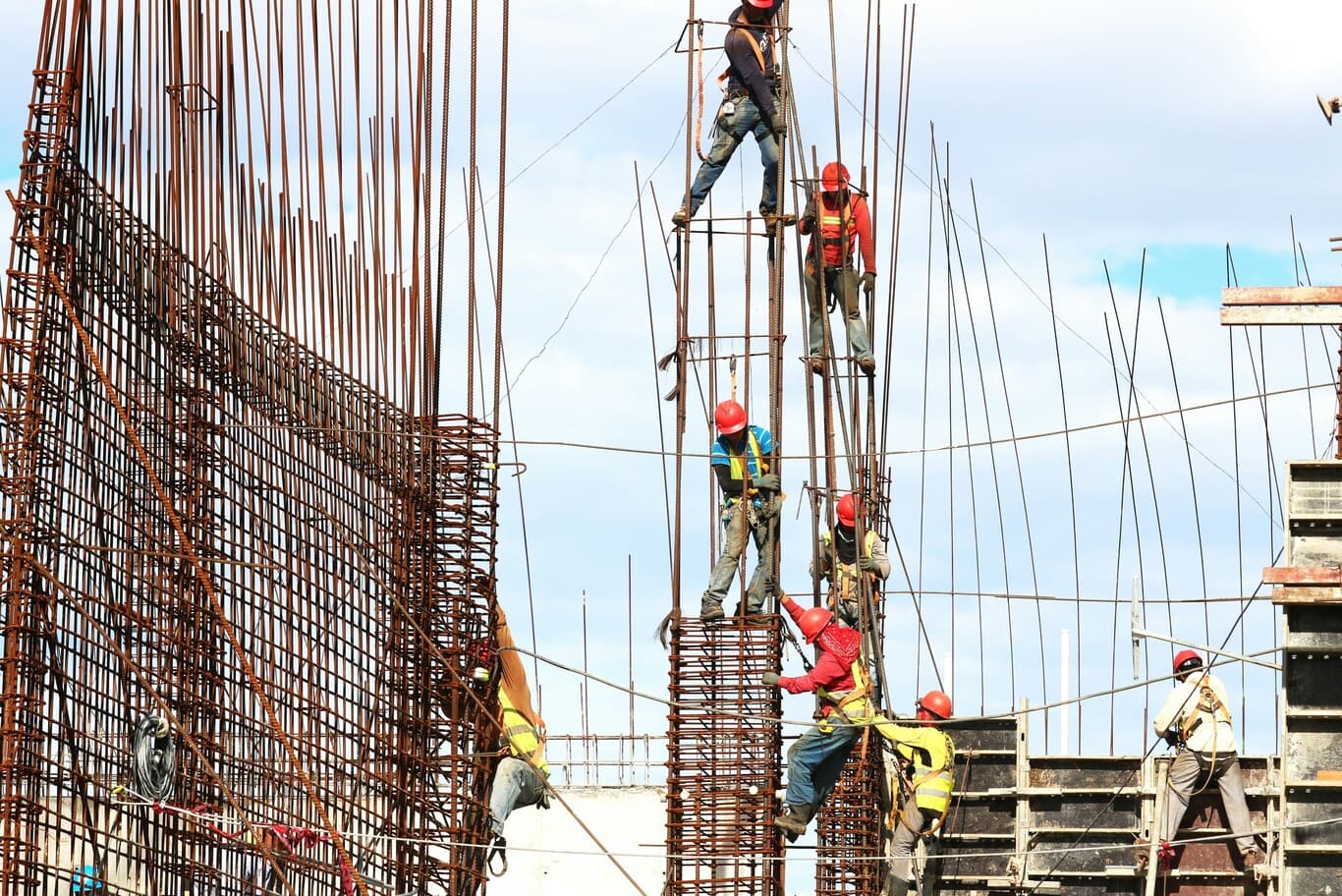
Capital Associated's approach to workforce and labour cost management
Capital Associated structures trade procurement against programme phasing from the pre-construction stage, with mobilisation lead times built into the master programme as fixed constraints rather than variable assumptions. Welfare compliance — accommodation provision, health insurance, transport, and worker committee requirements — is treated as a standing employer obligation across all projects. Certification requirements are specified in subcontract procurement documents for MEP and specialist packages, which is particularly relevant for the technical trade categories where certified and uncertified workers represent materially different performance and cost profiles in practice, not just on paper.
On food and beverage projects like the Meat Moot builds at JBR and Al Khawaneej — both of which required skilled MEP trades for grease exhaust systems, kitchen commissioning, and fire system integration within compressed fit-out programmes — trade mobilisation was planned against the commissioning and fit-out sequence from the outset, with kitchen MEP trades mobilised ahead of fit-out completion so that DM and Civil Defence inspection windows didn't create schedule dependency on trade availability. That kind of sequencing only works if the trade procurement timeline sits inside the construction programme rather than running parallel to it.
Get in touch
If you're planning a construction project in Dubai and want to discuss trade requirements, labour cost structures, and programme planning for your specific scope, get in touch with the Capital Associated team.